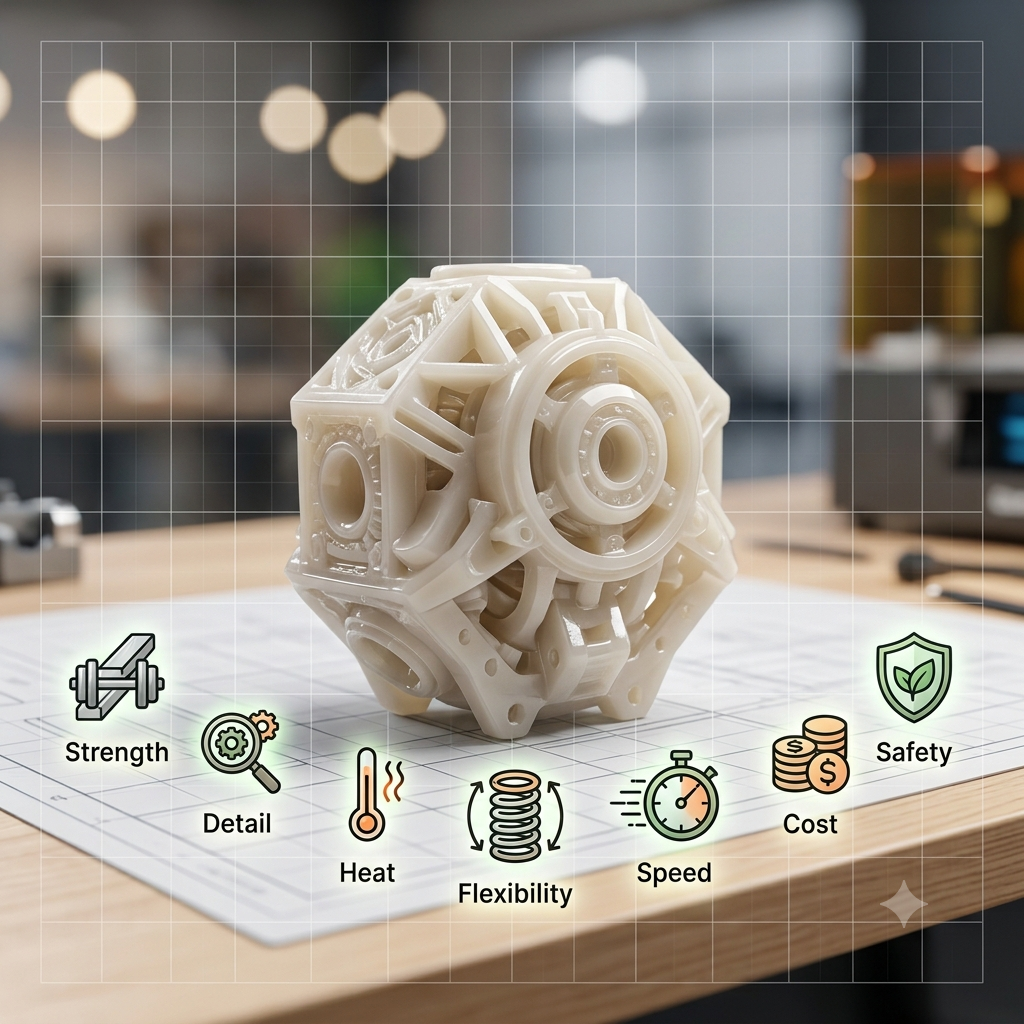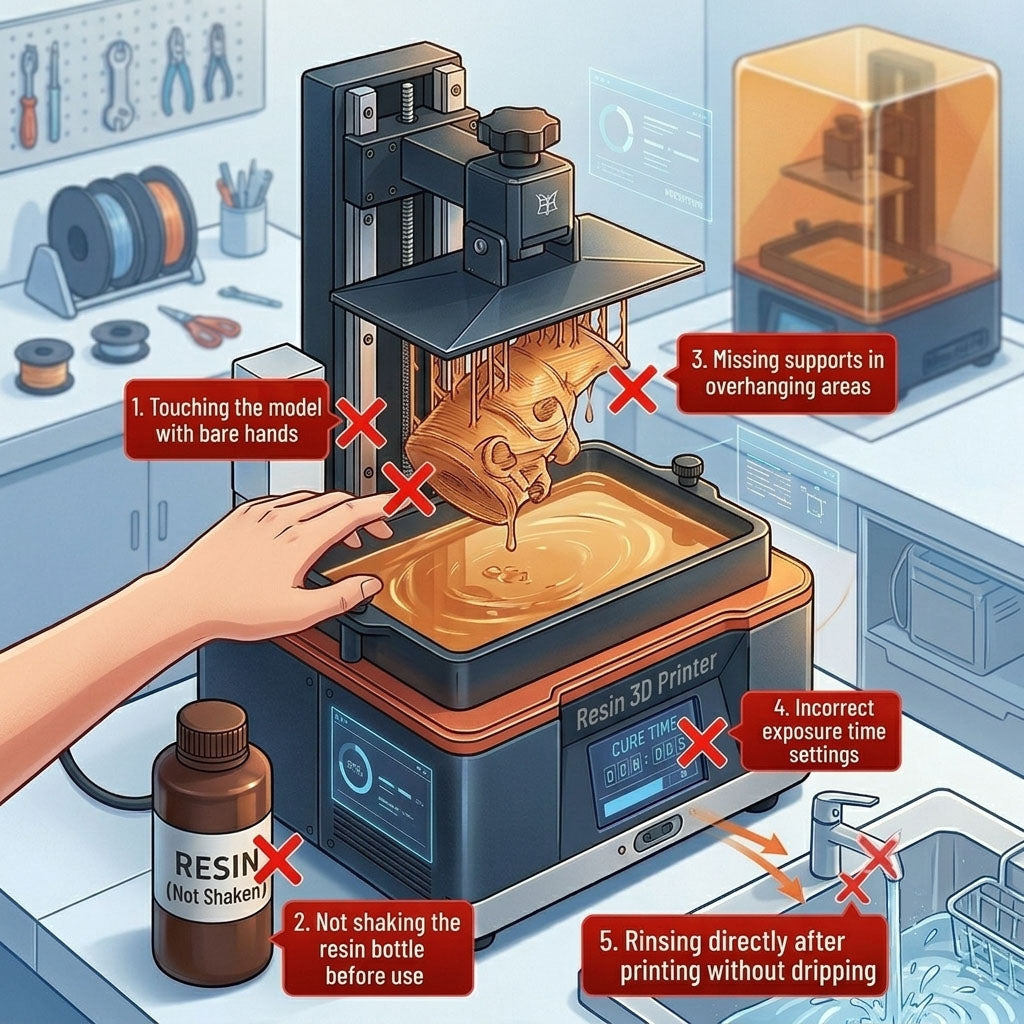

For decades, moving a product from concept to production was slow and expensive, requiring design, tooling, prototyping, testing, and mass production. This process often took months or years and made changes costly.
Today, resin 3D printing is transforming this workflow. Once used mainly for prototyping, it has become a reliable manufacturing solution. Advanced 3D printer resin materials now produce highly accurate, strong, and durable parts with excellent heat, chemical, and mechanical resistance, widely used in aerospace, automotive, medical, and industrial applications.
More than a prototyping tool, resin 3D printing bridges the gap between prototype and production. With high-performance 3D printing resin, manufacturers can shorten development cycles, reduce tooling costs, and bring products to market faster.
What Is 3D Printer Resin and Why Does It Matter?
3D printer resin is a liquid photopolymer resin used in resin 3D printing to create highly detailed, accurate, and durable parts. Unlike FDM printing, which uses plastic filament, resin-based technologies cure liquid resin with UV light to build objects layer by layer, delivering smoother surfaces and finer details.
Today, 3D printing resin is used for much more than prototyping. Advances in materials have improved strength, heat resistance, and chemical resistance, making 3D printer resin suitable for functional parts and industrial manufacturing across aerospace, automotive, medical, and consumer industries.
What Is Resin 3D Printing?
Resin 3D printing is an additive manufacturing process that uses a resin 3D printer to cure liquid resin with light. Popular technologies include SLA, LCD, and DLP, all of which produce high-resolution parts with excellent dimensional accuracy and surface quality.
Key Advantages of Modern 3D Printing Resin
Modern 3D printing resin offers several advantages:
- High precision and smooth surface finish
- Excellent strength and toughness
- Strong heat and chemical resistance
- Multiple resin types for different applications
- Faster transition from prototype to production
Choosing the right resin helps improve print quality, reduce production costs, and achieve reliable results for a wide range of 3D printing projects.
From Prototype to Production with Resin 3D Printing
Resin 3D printing is redefining how companies move from prototype to production. By using high-performance 3D printer resin, manufacturers can quickly iterate designs, validate functionality, and produce end-use parts without relying on traditional tooling or long production cycles.
Faster Product Development
One of the biggest advantages of resin print technology is speed. Designers can go from CAD file to physical part in hours, enabling rapid testing and iteration. This accelerates product development and reduces the time required to bring new ideas to market. With resin 3D printing, teams can test multiple design versions efficiently and improve performance early in the process.
Lower Tooling Costs
Traditional manufacturing requires expensive molds and tooling, which often delays production and increases upfront costs. Industrial 3D printing with resin eliminates most of these barriers. Since parts are built directly from digital files, companies can significantly reduce tooling investment while maintaining high precision and consistency.
End-Use Manufacturing
Modern 3D printing resin materials are no longer limited to prototyping. High-strength formulations now support functional and end-use manufacturing applications. From fixtures and jigs to final consumer and industrial components, resin print technology enables reliable production with excellent surface quality and dimensional accuracy.
By combining speed, cost efficiency, and material performance, resin 3D printing bridges the gap between prototype and production, making it a key solution in modern industrial 3D printing workflows.
Choosing the Right Resin for Your Application
Selecting the right resin is one of the most important decisions in resin 3D printing, as it directly affects print quality, mechanical performance, and final application. Different resin types are engineered for specific needs, from basic prototyping to high-performance industrial 3D printing.
Standard Resin vs Engineering Resin
Standard resin is commonly used for general prototyping and visual models. It offers high detail, smooth surface finish, and easy printing, making it ideal for early-stage design validation and concept models in resin print workflows.
In contrast, engineering resins are designed for functional applications that require higher strength, durability, and resistance to stress. These materials are widely used in industrial 3D printing, where parts must withstand mechanical loads, heat exposure, or long-term use. Choosing between standard resin and engineering-grade materials depends on whether the goal is visual accuracy or functional performance.
SLA, LCD, and DLP Compatibility
Different resin 3D printer technologies also influence material selection. SLA, LCD, and DLP systems all use photopolymer resin, but each process has unique curing characteristics that can affect print results.
- SLA (Stereolithography) offers high precision and is often used for engineering and dental applications.
- LCD (Masked SLA) provides cost-effective printing with fast production speed, suitable for prototyping and small-batch manufacturing.
- DLP (Digital Light Processing) delivers excellent detail and consistency, making it ideal for high-resolution parts.
Understanding resin types and printer compatibility helps ensure optimal performance, better surface quality, and reliable results. By choosing the right resin for your application and matching it with the correct technology, manufacturers can improve efficiency across every stage of resin 3D printing—from prototype to production.
Industrial Applications of 3D Printer Resin
Industrial 3D printing with advanced 3D printer resin has expanded far beyond prototyping, becoming a key technology for producing functional, high-precision components across multiple industries. With improved material performance and reliability, high-quality resin is now widely used in demanding manufacturing environments.
Automotive and Aerospace
In the automotive and aerospace sectors, 3D printing materials must meet strict requirements for strength, heat resistance, and dimensional accuracy. Resin 3D printing enables the production of lightweight components, functional prototypes, and custom tooling with excellent detail and surface finish. Engineers rely on industrial 3D printing to accelerate design validation and reduce development cycles while maintaining performance standards.
Medical and Consumer Products
In the medical field, high-quality resin is used for surgical guides, dental models, and patient-specific devices that require high precision and biocompatibility. The smooth surface and fine resolution of resin parts make them ideal for applications where accuracy is critical.
For consumer products, 3D printing materials based on photopolymer resin allow brands to create customized products, detailed prototypes, and short-run manufacturing parts efficiently. This flexibility supports faster innovation and lower production costs.
Across all industries, industrial 3D printing with resin continues to bridge the gap between design and production, offering scalable solutions for both prototyping and end-use manufacturing.
The Future of Resin 3D Printing
The future of resin 3D printing is closely tied to advances in material science and the continuous evolution of additive manufacturing. As industries demand faster production, higher performance, and more sustainable solutions, photopolymer technologies are becoming increasingly important in modern manufacturing workflows.
Smarter Materials
Next-generation photopolymer resin materials are being engineered to deliver enhanced mechanical properties, improved heat resistance, and greater durability. These smarter formulations allow resin 3D printing to move beyond prototyping and into full-scale functional production. With better control over curing behavior and material performance, manufacturers can achieve higher precision, consistency, and reliability across complex applications.
Sustainable Manufacturing
Sustainability is also shaping the future of additive manufacturing. New developments in resin chemistry aim to reduce waste, improve energy efficiency during curing, and introduce recyclable or lower-impact materials. As a result, resin 3D printing is becoming a more environmentally responsible option compared to traditional manufacturing methods that rely on subtractive processes and tooling waste.
As photopolymer technology continues to evolve, resin 3D printing will play a larger role in digital manufacturing ecosystems. From rapid prototyping to scalable production, it is driving a shift toward more flexible, efficient, and sustainable additive manufacturing solutions.
FAQS: 3D Printer Resin
What is 3D printer resin?
3D printer resin is a liquid photopolymer material used in resin 3D printing. It hardens when exposed to UV light in a resin 3D printer, producing highly detailed and accurate parts for prototyping and manufacturing.
Which resin is best for industrial applications?
The best resin for industrial use depends on the application. Engineering-grade 3D printing resin offers higher strength, toughness, and heat resistance, making it suitable for industrial 3D printing and functional end-use parts.
Is resin stronger than filament?
It depends on the material type. Some advanced resin types provide excellent surface quality and detail, while FDM filament parts may offer better impact resistance. Choosing the right resin is key for balancing strength and precision.
How do I choose the right resin?
To choose the right resin, consider mechanical strength, flexibility, heat resistance, and your printing technology such as SLA, LCD, or DLP. Different resin types are optimized for different 3D printing applications.
What is the difference between SLA, LCD, and DLP?
SLA, LCD, and DLP are different resin 3D printing technologies that use light to cure photopolymer resin. SLA offers high precision, LCD is cost-efficient, and DLP provides fast and consistent curing for detailed parts.